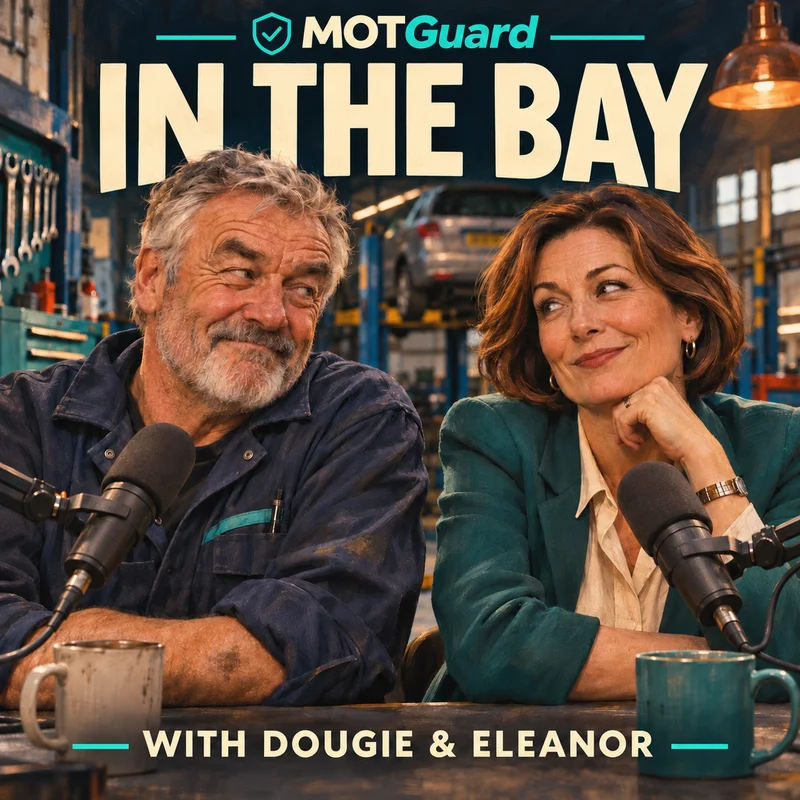
MOTGuard · In the Bay
Before you blame the car
Lighting · 3 min · With Dougie and Eleanor
Listen to this episode
All 40 episodes — choose another
- How this works
- Fog lamps that do not work
- The extra passenger
- Reading the beam
- Before you blame the car
- Headlamp aim
- The LED upgrade
- One lamp, two jobs
- Refuse or decline?
- Stopping a test you started
- Your licence, your name, your record
- Not fit to test today
- The log nobody filled in
- The man reading the notices
- When it goes wrong
- The pads you can't see
- Pipes and hoses
- Cables, rods and levers
- Hydraulics
- Electric parking brakes and four-wheel drive
- Which test for which vehicle
- Tread depth
- Condition, size and type
- Play you can feel
- Compliments to the mechanic
- Ball joints and dust covers
- Anti-roll bars
- Subframes
- Which test applies
- The kit car
- A different engine
- When the book is blank
- Smoke testing
- Before the probe goes in
- The hybrid with a leaking battery
- Hand controls and the road test
- You're done. Now what?
- The quality-control check, including your own
- Calibration, checks and the certificates
- Your risk rating and a site review
Transcript
DOUGIE: Apparently the headlamp tester is wrong.

ELEANOR: Has it said something unpopular?

DOUGIE: It has shown an unpopular result. Much the same offence, round here.

ELEANOR: Before we choose a defendant, let's establish the setup.

DOUGIE: Vehicle on the designated headlamp aim standing area. Equipment aligned to the vehicle following its manufacturer's instructions. Then we identify the beam image and assess the aim.

ELEANOR: The standing area is part of the procedure. Pointing the equipment at a car wherever it happens to have stopped is not an alternative method.

DOUGIE: Nor is lining it up with the badge because the badge looks central. On a complex lens system, with more than one lamp behind one lens, we need the exact centre of the dipped-beam pocket.

ELEANOR: The badge is decorative. I appreciate that this is disappointing news for the badge.

DOUGIE: We can have a good-looking alignment to the wrong part of the lamp. So we confirm which pocket is doing the job.

ELEANOR: Then there are the driver's beam-aim controls. Don't immediately move them to your preferred setting.

DOUGIE: We check without altering the setting first. If that would fail because the aim is too low, recheck with the control at its highest position.

ELEANOR: That is a specific recheck for that situation. It isn't an instruction to hunt through every setting until something passes.

DOUGIE: The control isn't a fruit machine.

ELEANOR: A fruit machine normally tells you when you have lost.

DOUGIE: There's a suspension detail as well. A vehicle with hydro-pneumatic suspension needs its engine running while we check headlamp aim.

ELEANOR: Follow that requirement where it applies. Don't turn one vehicle-specific instruction into an engine-running rule for every car.

DOUGIE: And when we check a manual levelling device, that's its own operation check. Switch on the dipped beams, operate the device, see that the aim changes, then return the control to its original position.

ELEANOR: Keeping that separate from the initial aim check prevents us muddling two instructions that sound similar. That levelling-device check does not apply to motor caravans.

DOUGIE: Here's what we do. Correct standing area. Manufacturer's equipment setup. Correct lamp pocket. Correct beam image. Then apply the control-setting and suspension instructions that belong to the vehicle.

ELEANOR: A short sequence. If you need a second page for the accusations, keep it separate.

DOUGIE: We can make minor headlamp aim adjustments during the test. That exception doesn't permit repairs generally during an MOT.

ELEANOR: So a poor result deserves a valid check, not an argument with a machine.

DOUGIE: Once we've established a valid check, we deal with the result. Next time: which limit actually applies to that height?